

The Mechanics of Healthy Hair: How Everyday Hair Care Can Prevent Unnecessary Damage

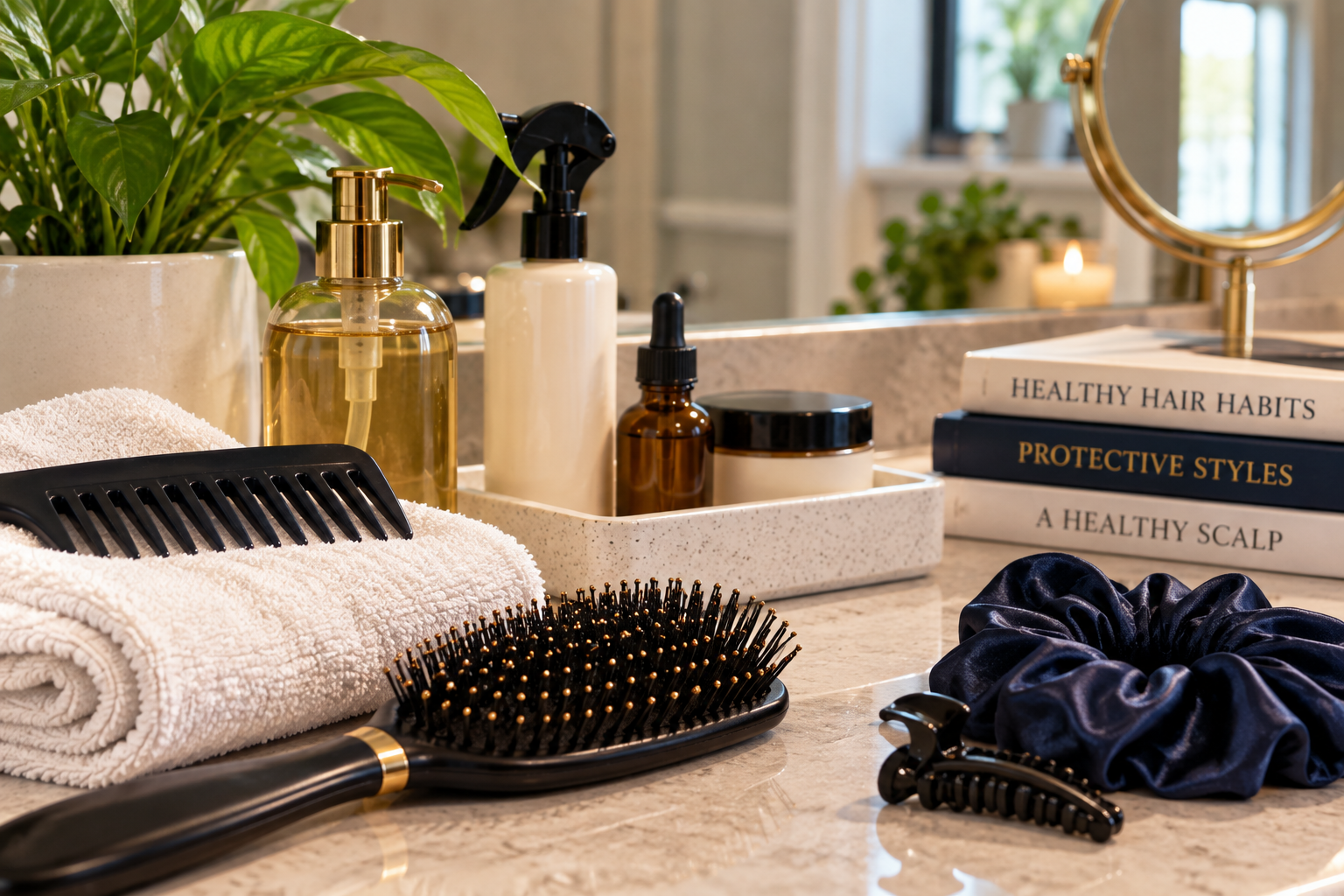
Subtitle: Healthy hair isn’t only about encouraging growth. It’s about preserving what grows.
Restore Hair Now Journal
Why Preventive Hair Care Matters
Preventive hair care deserves just as much attention as conversations about thinning, breakage, and hair loss. What we do to our hair every day—the tension, heat, friction, detangling, styling, and manipulation—can influence how well we preserve the hair we’re already growing.
But what about protecting the hair before there is a problem?
After more than 30 years as a cosmetologist, this is a conversation I believe we need to have more often.
Healthy hair isn’t only about encouraging growth. It’s about preserving what grows.
We spend a tremendous amount of time talking about what to do after women begin experiencing thinning, breakage, or hair loss.
But what about protecting the hair before there is a problem?
After more than 30 years as a cosmetologist, this is a conversation I believe we need to have more often.
Hair care isn’t simply:
Which shampoo should I buy?
Which oil should I use?
Which conditioner is best?
What can I put on my scalp to make my hair grow?
There is another part of hair care that is often overlooked:
The mechanics of hair care.
How are you handling your hair?
How much force are you placing on it?
How often are you manipulating it?
How much tension is being placed on your hairline and follicles?
How are you detangling?
How much heat are you using?
How much weight are you asking your natural hair to support?
Sometimes the issue isn’t simply whether our hair is growing.
We may not be retaining what we’re growing.
The Hair Shaft Is a Fiber
Once the hair emerges from the scalp, the visible portion—the hair shaft—is made primarily of keratinized cells. Unlike living tissue, the visible hair fiber cannot biologically heal itself after it has been damaged.
We can condition it.
We can lubricate it.
We can temporarily improve the way it feels and behaves.
We can reduce friction and improve manageability.
But once significant structural damage has occurred, the hair fiber does not regenerate itself.
That changes how we should think about hair care.
Instead of constantly trying to repair damage after we’ve created it, preventive hair care asks:
How can I reduce unnecessary damage in the first place?
This becomes especially important with textured, curly, and tightly coiled hair because the bends and curves along the fiber influence how the hair behaves during grooming and manipulation.
That doesn’t mean textured hair is unhealthy or inherently problematic.
It means we need to understand the hair we’re working with and handle it accordingly.
Mechanical Damage Is Cumulative
Think about everything one strand of hair may experience during its lifetime.
It may be:
washed,
conditioned,
detangled,
combed,
brushed,
stretched,
blow-dried,
flat-ironed,
braided,
twisted,
colored,
relaxed,
covered,
uncovered,
and restyled again and again.
One styling session may not create an obvious problem.
But mechanical stress can accumulate.
And remember—the ends of your hair are the oldest part of the hair fiber.
They’ve been through more shampoo days, more detangling sessions, more heat, more weather, more friction, and more manipulation than the hair closest to your scalp.
That’s why protecting your ends is so important when length retention is the goal.
1. Detangling: Technique Matters
Detangling should not become a battle between you and your hair.
When you encounter a knot and force a comb or brush through it, something eventually has to give.
Sometimes it’s the knot.
Sometimes it’s the hair fiber.
For textured hair, technique becomes extremely important.
Use enough conditioning and lubrication to provide slip.
Divide dense hair into manageable sections.
Begin where necessary to release the ends and work progressively through the section rather than repeatedly forcing a tool through resistance.
And choose tools appropriate for the density, condition, and texture of the hair.
Aggressive detangling is not the same as thorough detangling.
The objective is to separate the fibers while minimizing unnecessary tension and friction.
2. Tension: Your Hairstyle Shouldn’t Hurt
This may be one of the simplest preventive hair-care rules I can give you:
Pain is not the price of a good hairstyle.
Braids, ponytails, cornrows, extensions, weaves, and other styles can create mechanical tension when installed or worn too tightly.
Repeated pulling is especially concerning around vulnerable areas such as the:
- hairline,
- temples,
- edges,
- and areas supporting the weight of added hair.
A little discomfort should not automatically be accepted as evidence that a style is secure.
If your scalp is hurting, stinging, pulling, or throbbing after your hair is styled, pay attention.
Your scalp is giving you information.
And prolonged, repetitive traction can eventually contribute to traction alopecia. If follicular injury becomes advanced enough, some hair loss can become permanent.
That’s when hair care crosses into a medical concern and evaluation by an appropriate healthcare professional may be necessary.
3. Friction: The Damage We Rarely Think About
Your hair fibers are constantly coming into contact with something.
Other hair fibers.
Combs.
Brushes.
Towels.
Clothing.
Head coverings.
Pillows.
And even your hands.
That contact creates friction.
This is one reason conditioning is such an important part of hair care.
Conditioner isn’t simply there to make your hair smell good or feel soft.
A good conditioning process can improve manageability, lubrication, and slip, helping reduce the mechanical stress associated with grooming.
This is particularly important when working with longer, older, chemically processed, weathered, or highly textured hair.
When I talk about conditioning, I’m also talking about:
mechanical protection.
4. Heat: It’s the Dose That Matters
Heat is a styling tool.
I am not going to tell every woman that she can never blow-dry or flat-iron her hair again.
That’s not realistic hair care.
But we do need to understand how heat interacts with the hair fiber.
Think about thermal exposure as a combination of:
Temperature × Frequency × Time
How hot is the tool?
How frequently are you using it?
How many passes are you making?
How long is the hair being exposed?
What condition was the hair in before you started?
Has the hair already been chemically processed?
All of these things matter.
The goal isn’t necessarily to eliminate heat.
The goal is to use the least amount of thermal stress necessary to accomplish the styling objective.
5. Chemical Processing Changes the Fiber
Hair color, lighteners, relaxers, and other chemical services intentionally alter properties of the hair.
That doesn’t automatically make chemical services bad.
I’ve spent decades working professionally with chemically treated hair.
The important point is understanding that once the hair has been chemically processed, we’re working with a fiber whose properties have been changed.
That should affect the way we handle it afterward.
If hair has already undergone significant chemical processing and we add frequent high heat, aggressive detangling, repeated tension, and excessive manipulation, we’re stacking mechanical and chemical stressors.
Instead of simply asking:
“Can I do another chemical service?”
sometimes the better professional question is:
“What can this hair safely tolerate right now?”
6. Wet Hair Requires Thoughtful Handling
You’ve probably heard blanket statements such as:
“Never comb wet hair.”
Hair care isn’t always that simple.
Water changes the physical behavior of the hair fiber, but texture, density, condition, curl pattern, chemical history, and technique all matter.
For some tightly curled and coiled hair, trying to aggressively detangle the hair completely dry may create more unnecessary friction and breakage than carefully detangling properly conditioned hair with adequate slip.
The important question isn’t simply:
Wet or dry?
The better question is:
Under what conditions can I manipulate this particular hair with the least unnecessary damage?
That’s a hair-care question.
7. A “Protective Style” Is a Function, Not a Hairstyle Name
I really want women—and hair professionals—to think about this one.
We’ve created an entire category of hairstyles called:
Protective styles.
But a hairstyle isn’t protective simply because that’s what we’ve decided to call it.
We need to look at what the hairstyle is actually doing.
Ask:
Does it reduce unnecessary manipulation?
Is there excessive tension?
Is the added hair too heavy?
Can the natural hair underneath still be maintained?
Can the scalp be adequately cleansed?
Are the edges constantly being pulled?
How difficult will removal be?
Will the natural hair be aggressively detangled after weeks of being confined?
Those are the questions that determine whether a style is functioning protectively.
If we’re protecting the hairstyle while sacrificing the natural hair underneath it, we need to rethink what we’re protecting.
8. Extension Weight Matters
This is another mechanical issue that doesn’t receive enough attention.
Your natural hair is supporting whatever we attach to it.
More hair isn’t always better.
Longer isn’t always better.
Heavier isn’t always better.
The density and weight of added hair should make sense for the amount, density, strength, and condition of the natural hair supporting it.
This becomes particularly important when the hairline is already fragile or when density has begun to decrease.
A beautiful extension service should not require the client’s natural hair to support more mechanical load than it can reasonably tolerate.
Your Hair Has a Mechanical Budget
I want you to start thinking about your hair as having a mechanical budget.
Maybe you color your hair.
Maybe you straighten it occasionally.
Maybe you wear extensions.
Maybe you enjoy braids.
Maybe you manipulate your hair frequently because you like changing styles.
None of those things automatically makes your hair-care routine bad.
But when we begin stacking:
chemical processing + high heat + tight styling + heavy extensions + aggressive detangling + frequent manipulation
we are asking that hair fiber to tolerate a great deal.
Preventive hair care asks:
Where can I reduce unnecessary stress without giving up the hairstyles I enjoy?
That’s a much more realistic conversation than telling women they can’t do anything to their hair.
The Restore Hair Now Preventive Hair-Care Check
Before your next style or service, ask yourself:
TENSION
Does this style hurt, pull, or create unnecessary stress?
HEAT
Am I using more temperature or more passes than necessary?
FRICTION
Am I handling my hair roughly?
DETANGLING
Am I carefully releasing tangles—or forcing my way through them?
CHEMICAL HISTORY
How much processing has this hair already experienced?
WEIGHT
Is the added hair appropriate for the natural hair supporting it?
FREQUENCY
Am I repeatedly stacking high-stress services?
SCALP ACCESS
Can I properly cleanse, observe, and maintain my scalp?
If several of those answers concern you, another product may not be the solution.
The solution may be changing how the hair is being handled.
When Hair Care Becomes More Than Hair Care
There is also an important professional boundary here.
Cosmetologists are experts in hair care, styling, chemical services, grooming techniques, and the practical mechanics of working with hair.
Trichology expands that conversation into hair and scalp assessment, education, pattern recognition, supportive care, and appropriate referral.
Medical professionals have a different role.
When we begin seeing persistent scalp pain, burning, inflammation, pustules, unusual lesions, rapid progression, patchy loss, or findings concerning for scarring alopecia, we’re no longer talking only about better hairstyling technique.
That’s when appropriate medical evaluation becomes important.
These professions should complement one another, not pretend to replace one another.
Linda’s Clinical Perspective
After more than 30 years behind the chair, one thing I want women to understand is that healthy hair care isn’t about being afraid of your hair.
You can style it.
You can wear braids.
You can straighten it.
You can wear extensions.
You can color it.
You can enjoy your hair.
But every service has mechanics.
Tension matters.
Weight matters.
Temperature matters.
Friction matters.
Frequency matters.
Technique matters.
Sometimes we spend so much time searching for a product to grow more hair that we overlook the hair already sitting on our heads.
So before you ask:
“What can I use to make my hair grow?”
I want you to also ask:
“How well am I protecting the hair I already have?”
That is preventive hair care.
The Bottom Line
Healthy hair care isn’t just about products.
It’s about preservation.
It’s understanding the physical properties of the hair you’re working with and making choices that minimize unnecessary mechanical damage.
It’s knowing when your hair needs less manipulation.
It’s knowing when the heat is too much.
It’s recognizing when extensions are too heavy.
It’s understanding that a painful hairstyle isn’t something you simply have to tolerate.
And it’s recognizing that a “protective style” should actually protect.
Healthy hair isn’t only about encouraging growth. It’s about preserving what grows.
— Linda Boyce
Certified Trichologist | Cosmetologist | Non-Surgical Hair Replacement Specialist
Restore Hair Now Trichology & Non-Surgical Hair Replacement Center
Educational note: This Journal is for educational purposes and is not intended to diagnose or treat a medical condition. Persistent or unexplained hair or scalp changes should be evaluated by an appropriately qualified healthcare professional