

Vitamins, Minerals & Hair Loss: What If Your Body Isn’t Absorbing What You Need?
Restore Hair Now Journal
Volume 1 • Issue 4
Category: Hair Wellness
Reading Time: 9–10 minutes
Written by Linda Boyce
Certified Trichologist | Non-Surgical Hair Replacement Specialist | Certified Health Coach
Introduction
One of the questions I hear frequently is:
“Linda, what vitamin should I take for my hair?”
And my answer is usually another question:
“Do we know that you’re actually deficient?”
Because when it comes to vitamins, minerals, overall health, and hair loss, the conversation is much bigger than simply taking a supplement.
You can eat nutritious foods.
You can buy expensive vitamins.
You can take a handful of supplements every morning.
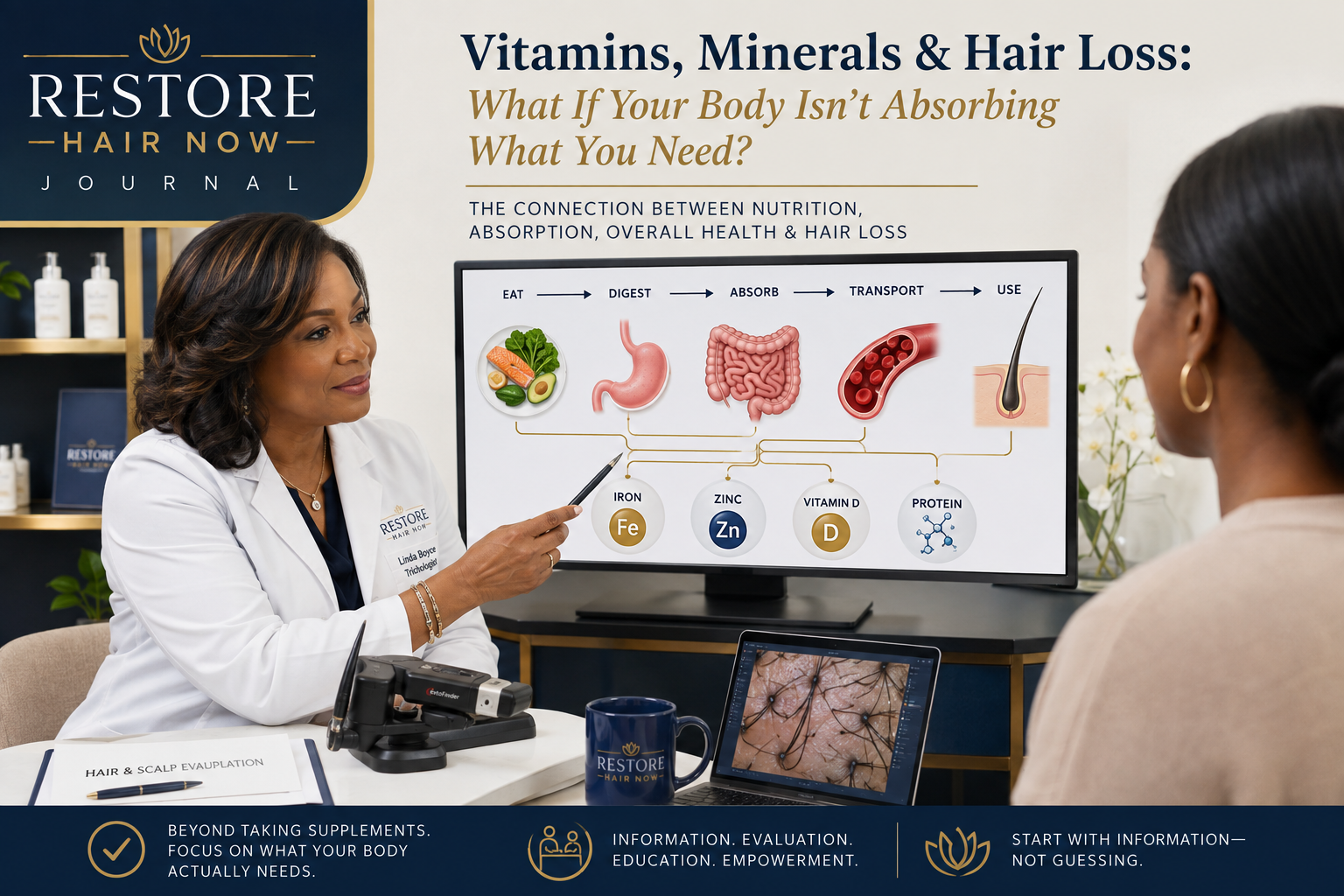
But your body still has to digest, absorb, transport, and use those nutrients.
And if something interferes with that process, what you’re consuming and what your tissues actually receive may not be the same thing.
Hair follicles are among the most metabolically active structures in the body. They require adequate energy, protein, vitamins, minerals, and normal cellular function to participate in a healthy growth cycle. Reviews of the scientific literature support a role for micronutrients in normal follicle development, although the relationship between specific supplements and hair growth is not always straightforward.
That is why I believe we need to stop asking only:
“What should I take?”
And start asking:
“What does my body actually need, and is it able to use it?”
Eating It Is Not the Same as Absorbing It
When you eat food, digestion begins breaking it down into smaller components.
Proteins become amino acids.
Fats are broken down into fatty acids.
Carbohydrates become smaller sugars.
Vitamins and minerals must then be released from food, absorbed through the digestive tract, carried through the bloodstream, and made available to tissues throughout the body.
So adequate nutrition involves several steps:
Intake → Digestion → Absorption → Transport → Utilization
A disruption anywhere along that chain may influence nutrient status.
This is why someone can have what appears to be a reasonably balanced diet but still develop a nutrient deficiency under certain circumstances.
What Can Affect Nutrient Absorption?
There isn’t one single cause.
Poor nutrient absorption can occur with certain gastrointestinal diseases, after some types of gastrointestinal surgery, with chronic digestive disorders, or because of interactions involving food, supplements, and medications.
The important point is this:
Malabsorption is a medical issue and should not be assumed simply because someone has hair loss.
Hair loss alone cannot tell us that someone is failing to absorb nutrients.
But when hair changes occur alongside symptoms such as chronic gastrointestinal problems, unexplained weight changes, fatigue, or documented nutrient abnormalities, those findings may justify further evaluation by the appropriate healthcare professional.
Why Nutrients Matter to Hair
Hair production requires rapidly dividing cells.
That means follicles need adequate raw materials to function normally.
Research has evaluated nutrients including:
- Iron
- Zinc
- Vitamin D
- B vitamins
- Selenium
- Vitamin A
- Vitamin C
- Protein
But there is an important distinction:
A nutrient can be necessary for hair growth without supplementation benefiting everyone.
A recent review concluded that vitamins seem most likely to improve hair health when a true deficiency exists; evidence supporting supplementation in otherwise healthy people with normal nutrient status remains limited.
That distinction is critical.
Iron and Ferritin
Iron is one of the nutrients most frequently discussed in connection with hair shedding.
The body needs iron for hemoglobin production and oxygen transport, among many other functions.
Low iron stores may be associated with certain forms of diffuse hair shedding, particularly telogen effluvium, although researchers continue to debate optimal thresholds and how strongly ferritin levels predict hair loss in every individual.
A 2026 systematic review and meta-analysis found that people with telogen effluvium had, on average, lower ferritin and vitamin D levels than control groups, though the authors also noted substantial variability among studies.
This does not mean every person with shedding needs iron.
The American Academy of Dermatology specifically advises that iron supplementation should generally be based on evidence of deficiency because excess iron can be harmful.
Zinc
Zinc participates in numerous cellular processes, including protein synthesis, immune function, and tissue repair.
Severe zinc deficiency can be associated with hair changes and hair loss.
But again, more isn’t automatically better.
The AAD lists inadequate zinc intake among nutritional deficiencies that can contribute to noticeable hair loss and advises against supplementing indiscriminately when blood levels are normal.
Vitamin D
Vitamin D has attracted considerable attention in hair-loss research because vitamin D signaling plays a role in skin and follicular biology.
Studies have found associations between lower vitamin D levels and several forms of alopecia, but association doesn’t automatically prove that vitamin D supplementation will reverse hair loss.
Reviews continue to describe the evidence as promising but incomplete, particularly regarding vitamin D as a direct hair-loss treatment.
That’s another reason testing and clinical context matter.
Protein Matters Too
Hair is composed largely of keratin, which is a protein.
Very low protein intake can disrupt normal hair cycling and contribute to shedding.
The AAD recognizes inadequate protein intake as a potential contributor to hair loss.
This is particularly relevant when someone:
- Restricts calories aggressively
- Follows a highly limited diet
- Experiences rapid weight loss
- Has difficulty eating adequate amounts
- Has a medical condition affecting intake or digestion
Again, the goal isn’t simply “eat more protein.”
The goal is to determine whether adequate nutrition is actually being consumed and whether there is a reason that needs further evaluation.
What About Biotin?
Biotin has almost become synonymous with hair supplements.
But biotin deficiency is uncommon in the general population.
Taking extra biotin when there is no deficiency has not been established as a universal hair-growth solution.
The AAD recommends taking biotin, iron, or zinc supplements specifically when testing indicates deficiency rather than assuming everyone with hair loss needs them.
High-dose biotin can also interfere with certain laboratory tests, which is another reason supplementation should not be treated casually.
The Problem With “Hair Vitamins”
Walk into almost any beauty store and you’ll find bottles promising:
Stronger hair. Longer hair. Faster growth.
But the problem with supplement-first thinking is that it can skip the most important question:
What is actually causing the hair loss?
If the cause is:
- CCCA
- Traction alopecia
- Female pattern hair loss
- Thyroid disease
- Autoimmune alopecia
- Medication-related shedding
- Scalp disease
a vitamin is not automatically going to correct the underlying problem.
The AAD notes that inadequate biotin, iron, protein, or zinc can contribute to hair loss—but it also recognizes many other medical, genetic, inflammatory, and mechanical causes.
Hair loss deserves an assessment, not an assumption.
Linda’s Clinical Perspective
This is where I believe my health-coaching background and trichology training come together.
When I see someone with hair loss, I don’t want to immediately ask:
“Which supplement are you taking?”
I want to understand the bigger picture.
What are you eating?
How often are you eating?
Have you experienced significant weight loss?
How is your digestion?
Have there been changes in your health?
Do you have recent laboratory results?
Are there medications or medical conditions that could be relevant?
What does your scalp look like?
What pattern of hair loss are we actually seeing?
These questions do not diagnose nutrient malabsorption.
But they can tell us when the hair story might require us to look beyond the hair.
That’s the part I believe is often missed.
A supplement bottle cannot replace an assessment.
And a normal-looking diet does not always tell us what is happening inside the body.
The Hair Follicle Is Not First in Line
Here’s another concept I often explain to clients.
Hair is important to us emotionally and cosmetically, but hair growth is not one of the body’s essential survival functions.
When the body is under significant physiological stress or lacks adequate resources, normal hair cycling may be affected.
That’s one reason illness, major stressors, rapid weight loss, inadequate nutrition, and certain deficiencies can sometimes be followed by increased shedding.
The body is constantly allocating resources.
Hair can reflect that larger physiological picture.
Don’t Supplement Blindly
This is one of the most important messages in this week’s journal.
More is not always better.
Certain vitamins and minerals can cause harm when taken excessively.
That includes nutrients people commonly associate with hair health.
Scientific reviews emphasize that evidence for supplementation is strongest when deficiency is present, while evidence for routine high-dose supplementation in people with normal levels remains limited.
So before spending hundreds of dollars on supplements, it may be more useful to ask whether evaluation or appropriate laboratory testing is indicated.
Myth vs. Fact
Myth: If I’m eating healthy, I cannot be nutrient deficient.
Fact: Diet is only one factor affecting nutrient status. Medical conditions, restricted intake, and other factors may influence digestion, absorption, or utilization.
Myth: Everyone experiencing hair loss should take biotin.
Fact: Biotin supplementation is not a universal treatment for hair loss, particularly when deficiency is absent.
Myth: If one vitamin is good for hair, taking more should work better.
Fact: Excess intake of some nutrients can be harmful. Supplementation should be based on actual need.
Myth: A vitamin deficiency is the cause of most hair loss.
Fact: Hair loss has many potential causes, including genetic, inflammatory, hormonal, medical, nutritional, and mechanical factors.
Frequently Asked Questions
Can vitamin deficiencies cause hair loss?
Yes. Deficiencies in nutrients such as iron, zinc, protein, and certain vitamins may contribute to hair loss in some individuals.
Can I have a deficiency even if I take supplements?
Potentially. Nutrient status depends on intake, absorption, medical conditions, interactions, and other factors. A healthcare professional can determine whether testing is appropriate.
Which vitamin is best for hair growth?
There is no single “best” vitamin for everyone. The relevant nutrient depends on the individual’s actual nutritional status and the cause of the hair loss.
Should everyone with hair loss have blood work?
No. Testing should be individualized based on history, symptoms, pattern of hair loss, and professional assessment.
Will correcting a deficiency make hair grow back?
When a nutrient deficiency is contributing to non-scarring hair loss, correcting that deficiency may help support recovery. However, outcomes depend on the underlying diagnosis, and permanently scarred follicles cannot be restored simply through supplementation.
Key Takeaways
- Eating nutrients and absorbing nutrients are not the same thing.
- Vitamins and minerals are important for normal follicular function.
- Deficiency may contribute to certain forms of hair loss.
- More supplementation is not automatically better.
- Hair loss has many causes beyond nutrition.
- Testing and professional evaluation should guide supplementation when appropriate.
- Hair can sometimes provide clues about what’s happening elsewhere in the body.
Ready to Look Beyond the Hair?
If you’re experiencing persistent shedding, thinning, scalp changes, or unexplained changes in your hair, don’t assume you simply need another supplement.
A comprehensive Hair & Scalp Evaluation allows us to examine the pattern, review relevant health and lifestyle history, and determine whether additional evaluation by your physician, dermatologist, registered dietitian, or another healthcare professional may be appropriate.
Start with information—not guessing.
Book Your Hair & Scalp Evaluation
This article is for educational purposes only and is not intended to diagnose, treat, cure, or prevent disease. Supplements and laboratory testing should be discussed with an appropriately qualified healthcare professional.
Related Posts
Understanding CCCA: The Silent Hair Loss Condition Every Black Woman Should Know About
-
Posted by
Linda
CCCA is the most common form of scarring hair loss affecting Black women, yet many women don’t recognize the early warning signs until permanent damage has occurred. Learn what CCCA is, why early detection matters, and how protecting your scalp health may help preserve your hair.